

There is a temptation, particularly when a project deadline is looming, to put plants in the ground and hope for the best. But experienced landscapers, revegetation specialists, and horticulturalists across Australia know that what happens before planting is just as critical as the planting itself. Getting the soil moisture balance right at the outset is one of the single most important steps you can take to protect your investment, reduce establishment failures, and set any planting project up for long-term success.
Australia's climate throws unique challenges at anyone working with soil. From the bone-dry summers of Western Australia to the clay-heavy profiles of eastern states, poor water retention and uneven soil moisture are genuinely common problems, not exceptions. Whether you are establishing a streetscape of native trees, restoring a degraded revegetation site, or laying down a new lawn, the condition of the soil before the first plant goes in the ground will determine everything that follows.
What Does Soil Moisture Balance Actually Mean?
Soil moisture balance refers to the soil's ability to absorb, retain, and release water in a way that keeps it available to plant roots over time. It is not simply about whether the soil is wet or dry at any given moment. Balanced soil moisture means water moves through the profile evenly, is held in the root zone long enough for uptake, and drains adequately so that roots are never waterlogged or starved of oxygen.
Many Australian soils, particularly sandy soils common in Western Australia, struggle with hydrophobicity. This is where the soil surface repels water rather than absorbing it, causing runoff and leaving the root zone dry even after rainfall or irrigation. Clay-dominant soils can have the opposite problem: they hold too much water in some areas while developing hard, dry pockets in others. Both scenarios create an imbalanced moisture environment that stresses plants from the moment they are established.
The consequences of getting this wrong go beyond plant aesthetics. Poor moisture balance leads to increased irrigation requirements, higher plant mortality rates, the need for costly replacements, and more maintenance labour over the life of the project. For councils, contractors, and environmental projects where budgets are finite, these are significant risks.
The Problem with Skipping Soil Preparation
One of the most common mistakes in planting projects is treating soil preparation as an optional extra rather than a core step. A plant placed into dry, hydrophobic, or structurally poor soil is immediately under stress, and that stress compounds as temperatures rise and rainfall becomes irregular.
When soil moisture is not balanced before planting, a few things tend to happen. Water applied during establishment runs off rather than penetrating to the root zone. Nutrient availability drops because many nutrients only become soluble and plant-accessible when dissolved in water. Root development is inhibited because roots preferentially grow toward moisture, and in uneven soil they either stall or develop in ways that reduce long-term structural stability for the plant.
In revegetation and large-scale tree planting projects, where hand watering is impractical and irrigation systems may be limited, the stakes are even higher. Plants that cannot access consistent soil moisture within the first growing season are very unlikely to establish at all.
Assessing Your Site Before You Start
Good soil moisture restoration begins with assessment. Before any amendment or treatment is applied, understanding what the soil is actually doing will save both time and money.
Simple field tests can reveal a lot. A basic water infiltration test, where you pour a set volume of water onto the surface and time how quickly it absorbs, will quickly identify hydrophobic or compacted soils. Digging a small pit and observing the soil profile will show layering, organic matter content, colour variations that indicate drainage patterns, and whether the soil structure is likely to support healthy root development.
For larger or more complex projects, a professional soil test can provide pH readings, nutrient profiles, and a clearer picture of textural composition. This kind of data gives you the best possible foundation for making informed decisions about which amendments to apply and in what quantities.
Restoring Moisture Balance: A Practical Approach
Restoring soil moisture balance is not a one-product fix. It typically involves a combination of physical preparation, the right soil amendments, and establishing good watering practices from the outset.
Breaking Up Compaction and Improving Structure
Compacted soil is a common culprit for poor moisture infiltration. Whether caused by heavy machinery on site, prolonged foot traffic, or naturally dense clay subsoils, compaction reduces pore space in the soil and limits the movement of both water and air. Before applying any amendments, compacted areas should be de-compacted using appropriate tools, whether that is a rotary hoe for larger areas or a cultivator for more targeted work.
Once the physical structure is opened up, organic matter can be incorporated to improve long-term soil health. Good organic matter creates the kind of crumbly, porous soil structure that holds moisture while still draining freely.
Addressing Hydrophobicity with Soil Wetting Agents
For sandy or naturally hydrophobic soils, a quality soil wetting agent is often the most direct way to restore the soil's ability to absorb and hold water. Wetting agents work by reducing the surface tension that causes water to bead up and run off rather than penetrate the profile. Applied before or at the time of planting, they can dramatically improve water infiltration and distribution through the root zone.
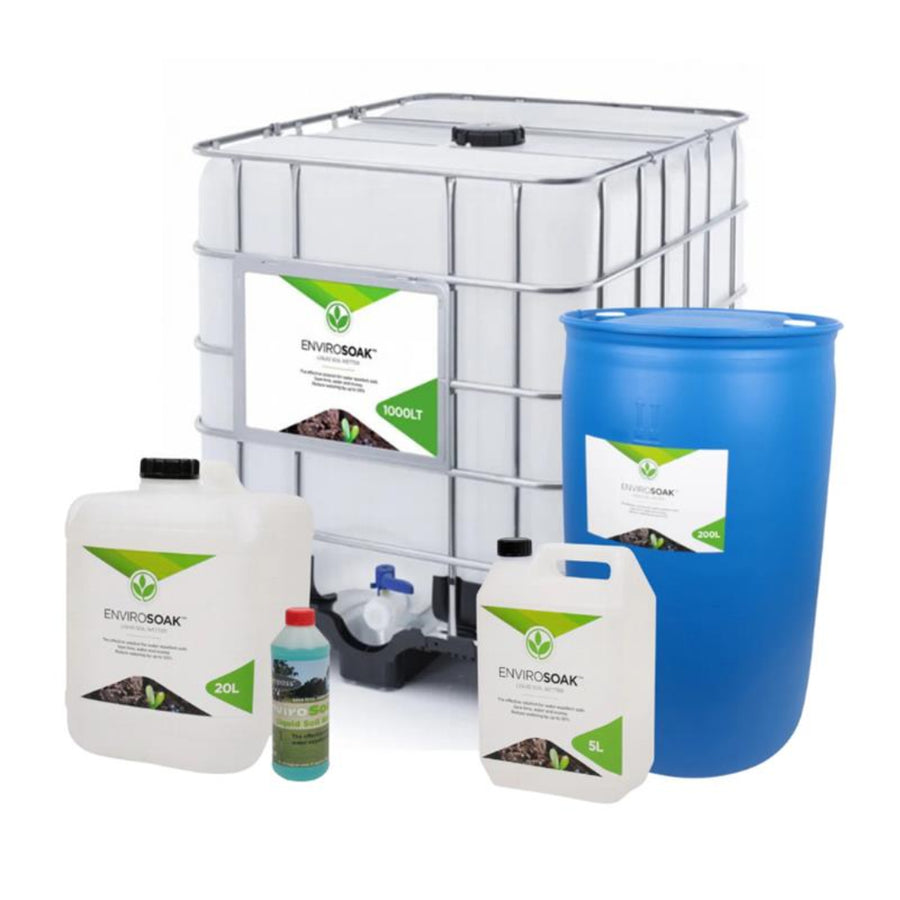
StrataGreen Envirosoak Liquid Soil Wetter
Our Soil Improvement & Watering collection includes a solid range of wetting agents and soil surfactants suited to a variety of soil types and project scales, from small garden applications through to large-scale turf and revegetation work.
Using Soil Conditioners to Build Long-Term Retention Capacity
Wetting agents improve immediate water movement, but for long-lasting moisture retention, a soil conditioner that works at root level is what makes the real difference.
We are the Australian distributor for TerraCottem soil conditioners, a product trusted by landscapers, councils, and environmental project managers across more than 40 countries. TerraCottem works by incorporating more than 20 synergistic components, including hydro-absorbent polymers, biostimulants, and fertiliser elements, into the root zone at planting time. The polymers absorb water during irrigation or rainfall, hold it within the polymer matrix, and release it on demand as plant roots penetrate and draw on the stored moisture. Crucially, this process does not simply make the soil "wetter"; it makes water available precisely where plants need it, when they need it.
TerraCottem carries Smart Drop Certification (formerly known as Smart Approved WaterMark), confirming its effectiveness in reducing irrigation requirements. Users across Australia consistently report water savings of between 40 and 80%, and the conditioner remains active in the soil for at least eight years from a single application at planting time. For projects operating under water-use restrictions or with limited irrigation infrastructure, this kind of performance is a genuine project asset, not just a nice-to-have.

The right TerraCottem for the job
TerraCottem is available in formulations suited to different planting applications: Universal for general trees, shrubs, revegetation, and gardens; Arbor for tree and shrub planting specifically; Turf for ornamental and sports lawns; and Complement for seasonal flower beds and horticulture. Browse the full range in our Soil Conditioners collection.
Pairing Amendments with the Right Watering System
Even the best soil amendment will underperform if the watering strategy at establishment is poorly matched to the site. Over-watering can wash amendments through the profile before they take effect; under-watering prevents the initial activation of hydro-absorbent materials and stresses newly planted stock.
For tree planting in particular, deep and infrequent watering is generally far more beneficial than shallow, frequent applications. Deep watering encourages roots to grow downward into the soil profile rather than staying near the surface, which builds greater drought resilience over time. Our Watering Systems range includes drip bags, tree watering rings, and related irrigation tools designed specifically for effective tree establishment, delivering water slowly and directly to the root zone rather than losing it to runoff or evaporation.
Matching Your Soil Prep to the Project Type
The right approach to soil moisture restoration varies depending on what you are planting and where.
For large-scale revegetation projects, particularly in degraded or marginal soils, the challenge is often stabilising moisture enough for native seedlings to survive the critical first season with minimal irrigation. In these environments, soil conditioners incorporated at planting time, combined with mulching over the root zone to reduce evaporation, can make the difference between a successful revegetation outcome and one that requires costly replanting. Our Revegetation & Tree Planting collection covers not just the planting supplies themselves but the ancillary products that support successful establishment, from tree guards through to stakes and ties.
For urban streetscape or council planting projects, where trees are going into compacted, heavily modified soils with limited irrigation, soil preparation becomes even more important. Trees planted in urban environments face significant stress from root zone compaction, impervious surfaces, and reflected heat. Starting with the best possible moisture balance and incorporating a high-quality soil conditioner gives these trees the foundation to establish and thrive without expensive maintenance intervention.
For turf projects, whether sports fields, council parks, or residential lawns, moisture uniformity across the profile is critical. Dry patches and hydrophobic sections create uneven growth and unsightly bare areas. Our Soil Wetting Agents and Turf Fertilisers are formulated to address exactly these issues, keeping turf green and consistent across varying soil conditions.
The Role of Biostimulants in Plant Establishment
One aspect of soil moisture management that is sometimes overlooked is the role of plant biology itself. Healthy, well-developed root systems are better at finding and extracting moisture from the soil, even when conditions are imperfect. Biostimulants support this by promoting the development of fine root hairs, which are the primary structures through which plants take up water and nutrients.
Our Biostimulants range complements soil preparation work by supporting root vigour from the moment of planting. When used alongside a quality soil conditioner, biostimulants give newly planted stock the best possible chance of developing the root architecture it needs to handle variable moisture conditions through the establishment period and beyond.
Getting the Timing Right
Soil moisture restoration is most effective when it is done before planting, not after. Amendments incorporated into the root zone at planting time are far more effective than surface applications made after the fact, because they are positioned exactly where the plant's roots will be actively growing. Products applied to the surface of already-planted areas face the challenge of working down through the profile to where they are actually needed.
This means that soil preparation should always be planned and budgeted for at the project design stage, not treated as something that can be added if time allows. The return on investment from getting soil moisture right before planting is significant: lower establishment failure rates, reduced irrigation costs, healthier plant growth, and less remediation work in the seasons that follow.
Strong Landscapes Are Built from the Ground Up
The ground itself is where every successful planting project begins. Taking the time to assess, prepare, and treat your soil before a single plant goes in is one of the most cost-effective decisions you can make, and one that pays dividends through every season that follows.
Ready to get your soil right before your next project kicks off?
Contact our team today for expert advice on the right products for your site, or browse our full Soil Improvement & Watering range and order with Australia-wide delivery.